|
|
|
 Haridwar, Rishikesh,
Laxman Jhulla
Haridwar, Rishikesh,
Laxman Jhulla
|
|
|
|
Legend holds
that one can attain moksha
(nirvana) just by the touch of Ganges
from
Haridwar or the Gateway to God. The
village has
got such an esteemed place in Indian way
of
thought. Haridwar is considered to be
blessed by
the trio of lords Brahma, Vishnu and
Mahesh
(Shiva).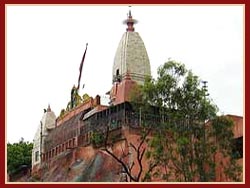 Har ki Pauri is one of
the holiest
ghats in India and it is believed that a
drop of
the immortal exilier fell here,
testimonies by
the footprint of Lord
Vishnu. Har ki Pauri is one of
the holiest
ghats in India and it is believed that a
drop of
the immortal exilier fell here,
testimonies by
the footprint of Lord
Vishnu.
Haridwar became an
integral part of Uttarakhand
on 9th November 2000 when the state was
carved
out of Uttar Pradesh. Today it houses
many
symbols of modern growth like Industrial
Estate
of State Infrastructure & Industrial
Development
Corporation (SIDCUL) and BHEL (Bharat
Heavy
Electrical Limited) and the ancillaries
of
these businesses. Many professional
builders
have constructed housing societies for
vacationers and retired people. Get to
know more
about Haridwar through this section.
Attractions
People visit Haridwar to
forget all their
worldly desires, anxieties and unholy
things
connected with their lives. Haridwar has
the
Panch Teerth mentioned in the Puranas
located
within the district mainly known as
Gangadwar
(Har-ki-Pauri), Kushwart Ghat, Kankhal,
Bilwa
Teerth (Mansa Devi) and Neel Parvat
(Chandi
Devi).
Chandi Devi Temple
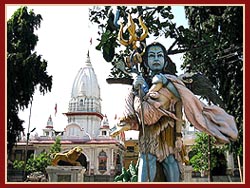 Situated on the top of
Neel Parvat, in Haridwar,
Chandi Devi Temple is one of the most
famous
temples of India. Considered to be one
of the
Shaktipeeth of North India, this place
is of
great religious significance. It is said
to have
the power to fulfill the wishes of
devotees and
this is why it is also known as
Siddhpeetha. Situated on the top of
Neel Parvat, in Haridwar,
Chandi Devi Temple is one of the most
famous
temples of India. Considered to be one
of the
Shaktipeeth of North India, this place
is of
great religious significance. It is said
to have
the power to fulfill the wishes of
devotees and
this is why it is also known as
Siddhpeetha.
Daksha Mahadev
Temple
Daksha Mahadev temple is
one of the most ancient
temples of Lord Shiva, situated in
Kankhal. The
temple is approximately 4 km away from
the main
township of Haridwar. Mythologies relate
this
temple to DakshaYagya. According to the
legends, Goddess Sati's father
DakshaPrajapati
performed a yagna, a holy ritual, at
this place,
but did not invite Lord Shiva, his
son-in-law.
Rishikesh
Rishikesh is a
small town situated 532 m (1,745
ft) above sea level in Dehradun district
of
Uttarakhand. Located about 42 Km from
the state
capital Dehradun and 25 Km from
Haridwar,
Rishikesh is an important destination
since it
acts as an entry point for pilgrimage to
the
four most holy Hindu pilgrimages in
India
commonly known as the Char Dham. It is
here
that holy river Ganga meets river
Chandrabhaga.
 The place got its name from Raibhya
Rishi who
got to see the divine form (Darshan) of
Lord
Vishnu here. In Skanda Purana the region
has
been mentioned as Kubjamrak. It is also
said
that Lord Rama did penance here for
killing
Ravana. Historically, Rishikesh was a
part of
the ancient Kedarkhand (or the modern
day
Garhwal), the supposed home of Lord
Shiva. River
Ganga flows through the town in its most
unruly,
turbulent and fierce form. Today
Rishikesh has
earned the sobriquet of the Yoga Capital
and
Adventure Sports Hub.
The place got its name from Raibhya
Rishi who
got to see the divine form (Darshan) of
Lord
Vishnu here. In Skanda Purana the region
has
been mentioned as Kubjamrak. It is also
said
that Lord Rama did penance here for
killing
Ravana. Historically, Rishikesh was a
part of
the ancient Kedarkhand (or the modern
day
Garhwal), the supposed home of Lord
Shiva. River
Ganga flows through the town in its most
unruly,
turbulent and fierce form. Today
Rishikesh has
earned the sobriquet of the Yoga Capital
and
Adventure Sports Hub.
Bharat
Mandir
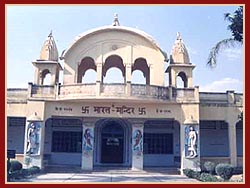
Bharat temple is situated in the
heart of the
township of Rishikesh. It is
approximately half
kilometer away from the Triveni Ghat,
the famous
river bank in the town. Said to be the
oldest
temple in Rishikesh, it is also regarded
as one
of the most ancient shrines in
India.
Nilkanth
Mahadev
Nilkanth Mahadev is an ancient temple
situated
at a height of 1675 m, on a hill above
Swarg
Ashram. It stands adjacent to the
mountain
ranges of Nar-Narayan, at a distance of
approximately 20 km from Rishikesh. It
is
enveloped between the valleys of
Manikoot,
Brahmakoot and Vishnukoot.
River Rafting
 River rafting is an adventurous
recreational
sport that is being explored by a wide
proportion of people now-a-days. In this
adventure sports, a raft is used to
navigate a
gushing river, making it a very
thrilling, at
times scaring and extremely breathtaking
experience.
River rafting is an adventurous
recreational
sport that is being explored by a wide
proportion of people now-a-days. In this
adventure sports, a raft is used to
navigate a
gushing river, making it a very
thrilling, at
times scaring and extremely breathtaking
experience.
Swarg
Ashram
Swarg
Ashram is a small township located 5 km
upstream from Rishikesh, on the left
bank of the
Ganges, opposite to Shri Shivanand
Ashram. It
can be reached by two ways - either by
crossing
river Ganges by boat or by walking
through the
Ram/Shivanand Jhula built across the
river.
Trekking
An outdoor activity that
involves hiking in
mountain regions is called trekking.
Rishikesh, apart from being an ideal
location
for rafting and cannoning, is also
considered
one of the best destinations for
trekking
activities in India. The strategic
location of
Rishikesh, in Uttarakhand - situated at
the
foothills of Himalayas, attracts lots of
trekking enthusiasts.
|
Other Covered Area
|

|
Aadi
Badrinath Temple
|
|
|
Laxman
Temple
|
|
|
Sachha
Akhileshwar
|
|
|
14 Story
Temple
|
|
|
Geeta
Bhawan
|
|
|
Ram
Jhula
Bridge
|
|
|
Parmarth
Niketan
|
Lakshman Jhula
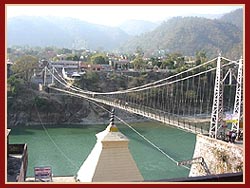
Lakshman Jhula,
the famous hanging bridge across
Ganga, is about 3 km from the main
township of
Rishikesh. It is 450 feet long and is
situated
at a height of 70 feet from the river.
 As per
mythological tales, once Lakshman, the
younger
brother of Lord Rama, crossed river
Ganga at the
same site where the bridge now stands.
At that
time, there was only a suspension
bridge, made
of jute. After this incident, the bridge
came to
be known as Lakshman Jhula. With time,
the
jute bridge eroded and a new iron bridge
was
built along the same path in
1939. As per
mythological tales, once Lakshman, the
younger
brother of Lord Rama, crossed river
Ganga at the
same site where the bridge now stands.
At that
time, there was only a suspension
bridge, made
of jute. After this incident, the bridge
came to
be known as Lakshman Jhula. With time,
the
jute bridge eroded and a new iron bridge
was
built along the same path in
1939.
Lakshman Jhula is actually
an adjoining bridge
across the Ganga, along the old route to
the
holy shrines of Badrinath and Kedarnath.
The
jhula has now become one of the most
visited
tourist spot of Rishikesh, not simply
because of
its ancient origin and religious
sanctity, but
also because of the grand temples and
wonderful
local market have come to be developed
around
it. A thirteen storey temple, called
Terah
Manzil, near the Lakshman Jhula is very
popular
amongst visitors. The top floor of this
temple
gives a wonderful view of the
surroundings.
Another temple around the bridge is
the
Lakshman temple, with Rishikund.
According to
locals, Lord Ram and Lakshman took bath
in the
kund, after killing Ravana, to get rid
of their
sins. The entire area around the
Lakshman Jhula
gives a mystic, holy and serene feeling.
As you
see people lost in the religious
traditions, the
entire area gets submerged in enchanting
mantras
and shlokas from the temples. The market
around
Lakshman Jhula is famous for wooden
goods,
Rudraksha, Idols of Gods and Goddesses,
holy
books, gems, local jewelries, clothes
and
excellent street food.

|
|
|
|